

Cart
0



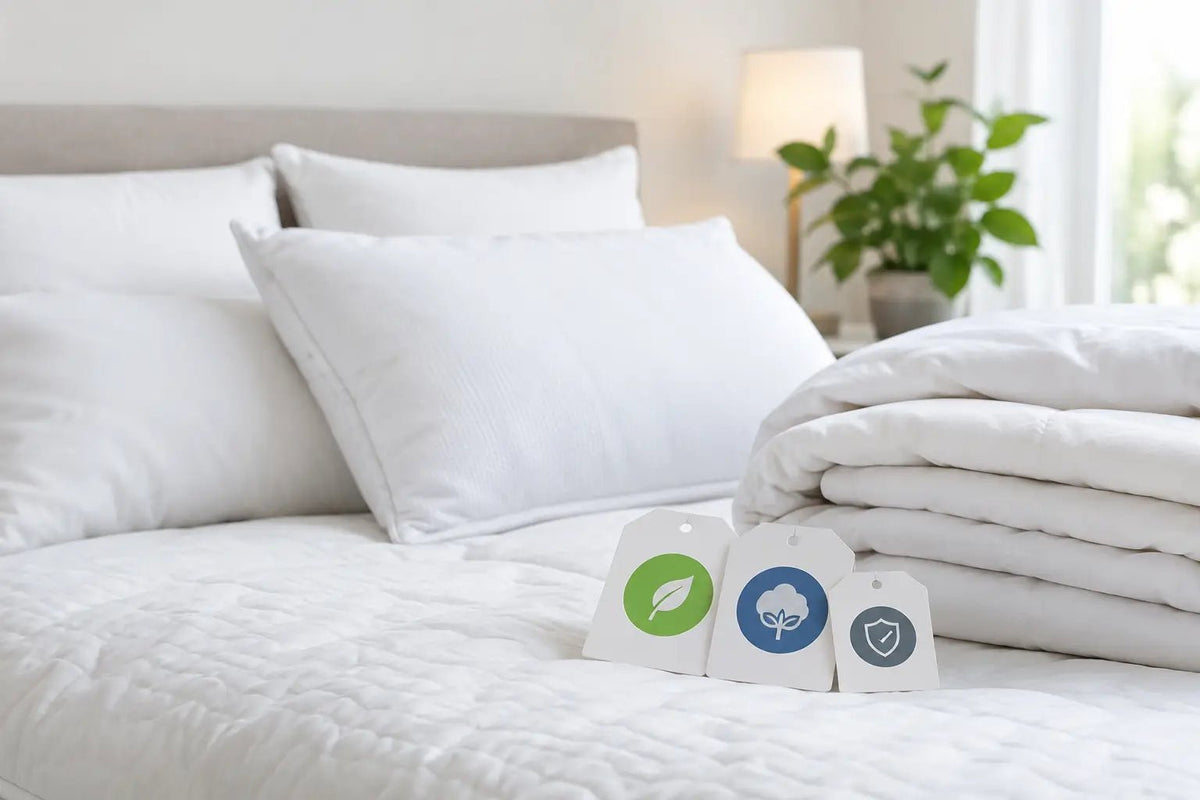
A sheet set can feel remarkably soft in the showroom and still leave you questioning what, exactly, is touching your skin for eight hours each night. This bedding certification guide cuts through the labels, seals, and vague promises so you can recognize meaningful proof of safety and responsible production - not simply polished packaging.
For hot sleepers, sensitive skin, and anyone building a more considered bedroom, certifications are not decorative badges. They are a way to ask better questions about fiber, dyeing, finishing, and the conditions behind the finished fabric. They also have limits. A certification can verify a specific standard, but it cannot automatically tell you whether sheets will stay cool, drape beautifully, or feel luxurious after years of washing.
What Bedding Certifications Actually Verify
The first rule is simple: read the claim as narrowly as it is written. A credible certification generally applies to a defined part of the supply chain, such as harmful-substance testing, organic fiber content, forest management, or factory practices. It rarely validates every environmental, comfort, and wellness claim on a product page.
That distinction matters with bedding. A product may be tested for certain harmful substances without being organic. It may use responsibly managed wood pulp without carrying a certification for the finished fabric. And a fabric may be exceptionally breathable without any certification designed to measure cooling performance.
The strongest product descriptions make those boundaries clear. Look for the certification name, the product or component it covers, and language that explains the claim without stretching it. A bare statement such as “eco-friendly” or “non-toxic” asks for trust without offering much evidence.
A note on “chemical-free” bedding
No textile is literally chemical-free. Fibers are processed, washed, colored, and finished through material systems that involve chemistry. The better question is whether the finished textile has been tested for harmful substances, whether its manufacturing is transparent, and whether unnecessary finishes have been avoided.
This is especially relevant for people prone to skin sensitivity. A credible safety certification does not guarantee that every individual will have the same experience, but it provides a more reliable starting point than an unsupported claim.
The Certifications Worth Knowing
Several standards appear often in premium bedding. Each serves a different purpose, and the most useful choice depends on the fiber and the claim being made.
OEKO-TEX STANDARD 100
OEKO-TEX STANDARD 100 is one of the most recognizable textile safety certifications. It tests textiles and components for a broad list of substances that may be harmful to human health. Depending on what is certified, testing can include the finished fabric as well as threads, buttons, dyes, and other elements.
For bedding, this is an especially practical signal because sheets have prolonged contact with the body. It speaks to chemical safety in the finished product, not whether a fiber is organic, biodegradable, or inherently cooler. If a brand cites OEKO-TEX, look for clarity on whether the exact product is certified rather than assuming the claim applies across an entire collection.
MADE IN GREEN by OEKO-TEX
MADE IN GREEN builds on product testing with added attention to traceability and responsible production. It is designed to indicate that a textile has been tested for harmful substances and made in facilities that meet specified environmental and social criteria.
It can be a meaningful marker for shoppers who want to look beyond the pillowcase in hand and consider how it was made. Still, it does not replace a close look at fiber content, fabric construction, or durability. Responsible production and exceptional sleep performance are related goals, but they are not interchangeable.
GOTS and organic claims
The Global Organic Textile Standard, commonly called GOTS, is most relevant to textiles made with organic natural fibers, particularly cotton. It addresses organic fiber content and sets processing criteria across the textile supply chain.
GOTS can be a strong signal when you are shopping for organic cotton bedding. It is not, however, a universal benchmark for every fiber. Bamboo lyocell is a regenerated cellulosic fiber, so comparing it to organic cotton solely by whether it carries a GOTS label misses the point. The right certification should fit the material, not merely sound familiar.
FSC and responsible forest sourcing
For wood-based cellulosic fibers, Forest Stewardship Council, or FSC, claims can help address where the raw material originates. FSC certification is associated with responsibly managed forests and can be relevant to the wood pulp used to create lyocell.
This is a sourcing standard, not a skin-safety test for a finished sheet set. It is most meaningful when a brand can explain the connection between its fiber source and the certification, rather than using forest imagery as a substitute for documentation.
A Bedding Certification Guide for Bamboo Fibers
“Bamboo” is not a complete material description. It tells you the plant source, not necessarily how that plant became fabric. The manufacturing method is central to both performance and the credibility of sustainability claims.
Bamboo viscose and bamboo rayon typically rely on chemical-intensive conversion processes to transform plant cellulose into a spinnable fiber. Bamboo lyocell also begins with cellulose, but it is made through a different solvent-spinning process that is widely regarded as more controlled and efficient when responsibly managed. The finished fabrics can both feel soft, yet the distinction matters when a brand presents bamboo as a cleaner, more advanced textile choice.
Certification should support this explanation, not replace it. Look for a brand that identifies the fiber honestly as bamboo lyocell or bamboo viscose, states what its safety certification covers, and avoids implying that bamboo alone guarantees environmental superiority. At Verleu, this material distinction is central because premium bedding should offer proof alongside its serene, cooling comfort.
What certifications cannot tell you about cooling
A safety or sourcing certification does not measure whether you will wake up overheated. Cooling performance depends on the fiber’s moisture management, yarn quality, weave, fabric weight, room temperature, mattress protector, comforter fill, and your individual sleep patterns.
Bamboo lyocell is valued for its smooth hand feel and ability to manage moisture, which can make the sleep surface feel drier and more comfortable for many warm sleepers. But it is still wise to treat claims of “cooling” as performance language that should be explained through fabric construction, not as a benefit proven by an unrelated certification.
How to Read a Bedding Label Before You Buy
Start with the fiber content. It should identify what the fabric actually is, not just the botanical source used somewhere in its origin story. If you see “bamboo,” seek more specificity: bamboo lyocell, viscose from bamboo, rayon from bamboo, or a blend.
Then match the certification to the claim. OEKO-TEX STANDARD 100 supports a harmful-substance testing claim. GOTS supports organic textile claims for eligible natural fibers. FSC can support responsible forest-sourcing claims. When a brand uses one seal to suggest all three benefits, pause.
Finally, evaluate the product as bedding, not as a label collection. Ask whether the fabric has the qualities your sleep requires: breathable comfort for night sweats, a smooth surface for sensitive skin, durable construction, and care instructions you can realistically follow. Certifications narrow the field. They do not choose the right sheet for you.
The Questions Premium Bedding Should Answer
A transparent brand should make it easy to find four details: the precise fiber composition, the certification’s name, what that certification covers, and how the fabric is made. You should not need to decode broad phrases such as “clean luxury” or “consciously crafted” on your own.
It should also be candid about trade-offs. Organic cotton offers a familiar natural-fiber story but may not provide the same smooth, moisture-managing feel as lyocell. Linen is airy and long-lasting but begins with a more textured hand. Bamboo lyocell can offer exceptional softness and temperature comfort, though quality varies significantly according to sourcing, processing, and weaving. There is no universal winner, only a more informed fit for your bedroom.
The most reassuring bedding is not the set with the most seals. It is the set whose material, testing, and performance story remain clear when you look past the label. Choose the fabric that lets you sleep like you deserve to, with comfort you can feel and standards you can understand.


