

Cart
0


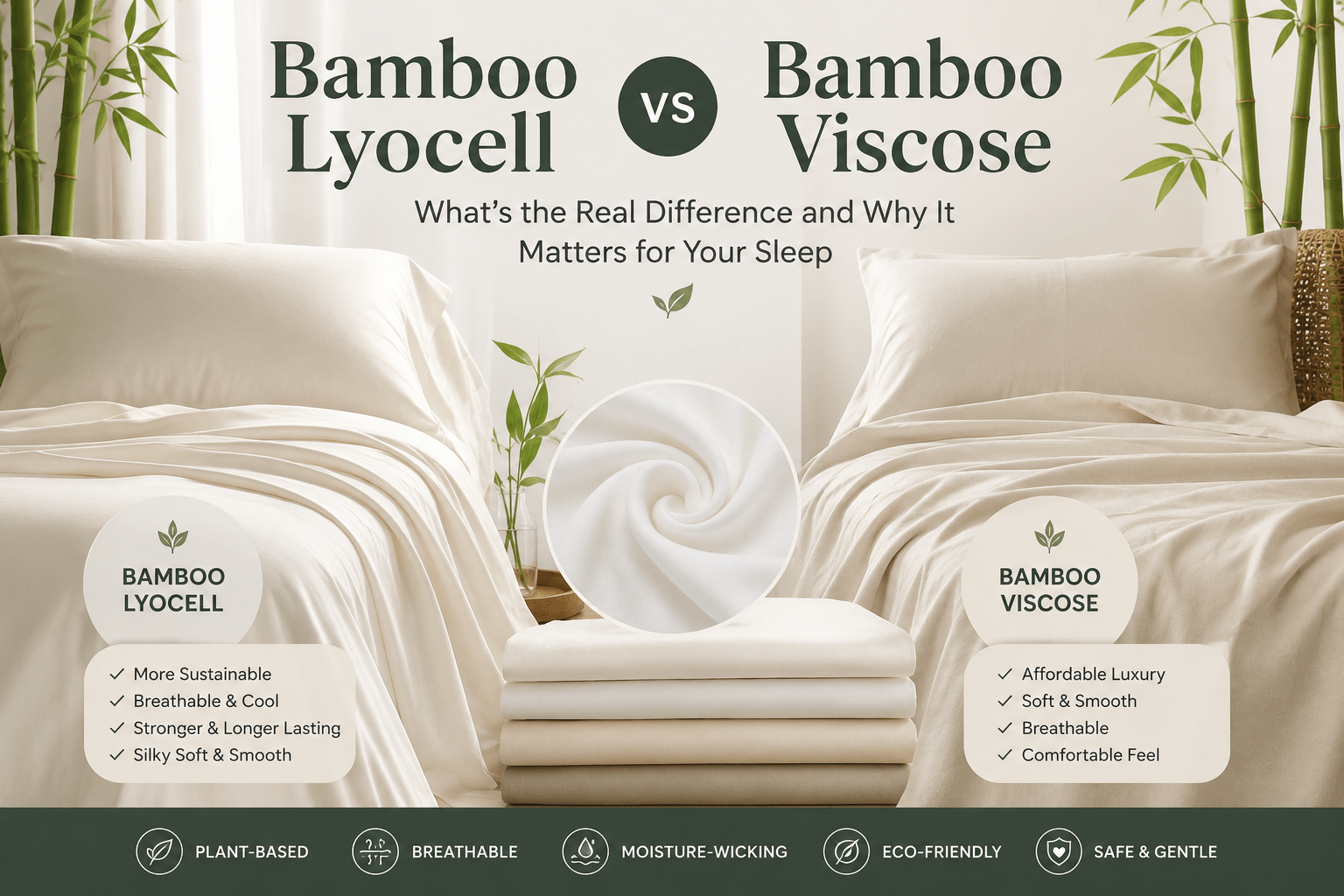
You're shopping for bamboo sheets. The label says "100% bamboo." The price looks right. The reviews seem decent. You add it to your cart - and six months later you're pulling off sheets that pill, feel oddly clammy by 2 AM, and have thinned out after a handful of washes.
The reason: "bamboo" is not one material. It's two. And the difference between them isn't a minor manufacturing detail - it determines how your sheets feel on your skin tonight, how long they last, and whether the brand made an honest product or a clever marketing decision.
Bamboo lyocell and bamboo viscose start with the same plant. Everything that matters happens after that.
The Manufacturing Gap Nobody Talks About
Both fabrics begin with bamboo pulp. Then the paths diverge completely.
How Bamboo Viscose Is Made
Viscose production - whether from bamboo, wood, or any other plant - relies on a chemical process developed in the late 1800s. The bamboo is dissolved using harsh solvents, primarily carbon disulfide, a toxic industrial chemical. The resulting liquid is then forced through tiny nozzles and hardened into fibers.
The problem isn't the starting material. It's what happens during processing. Carbon disulfide is classified as a hazardous substance by the EPA. In an open-loop system - which most viscose production still uses - the solvents aren't fully recovered. They're released into the surrounding air and waterways. Workers in viscose mills face documented occupational health risks. The finished fabric, once rinsed, contains residual chemical traces that OEKO-TEX testing can detect.
The fiber also loses structural integrity during this process. Harsh chemical breakdown weakens the bamboo's natural cell structure, leaving shorter, more fragile fibers. That's why bamboo viscose sheets - however soft they feel in the store - tend to pill, thin out, and degrade faster than the price tag suggested they should.
How Bamboo Lyocell Is Made
Lyocell uses an entirely different chemistry. The solvent is NMMO (N-methylmorpholine N-oxide) - non-toxic, and recovered in a closed-loop system that recycles up to 99% of it for reuse. No carbon disulfide. No open-loop chemical release. The bamboo's fiber structure is preserved through the process rather than degraded by it.
The result is a fiber that's longer, stronger, and more uniform than what viscose production yields. That structural difference determines everything downstream: how the fabric feels, how it manages moisture, and how long it holds up.
This is why products like Verleu's Héritage Bamboo Sheet Set are specifically made from 100% organic bamboo lyocell, not bamboo viscose. The distinction isn't branding. It's chemistry.
How They Actually Perform in Bed
The manufacturing differences translate into measurable performance differences - the kind you notice at 3 AM when you're either sleeping through the night or kicking off covers.
Cooling and Moisture Wicking
Bamboo viscose is marketed as a cooling fabric, and it's not a lie exactly - it's breathable compared to synthetic materials. But "cooling" in viscose works passively. The fabric sits against your skin and doesn't trap heat as aggressively as polyester. When it gets damp with sweat, though, it tends to hold onto that moisture. In humid conditions or for hot sleepers, it can start feeling clammy by the second half of the night.
Lyocell is built differently. Its fiber structure is naturally hydrophilic - water-absorbing, and the long-staple construction creates micro-channels that pull moisture away from the skin and release it into the air. Lyocell is roughly 50% more absorbent than cotton. For hot sleepers, that difference between passive breathability and active moisture management is the difference between waking up damp and not waking up at all.
The Verleu Héritage Bamboo Comforter and Héritage Bamboo Duvet Cover are engineered around the same lyocell moisture principle - the bedding system works together rather than each piece doing a separate job.
Softness - and Whether It Lasts
Both fabrics feel soft when new. The divergence happens after washing.
Viscose fibers are chemically weakened during production. Normal laundry cycles accelerate that degradation. Most people notice pilling starting around the 10-15 wash mark. By month six, the texture has changed noticeably. By year two, the sheet is a different object than what arrived in the packaging.
Lyocell's preserved fiber structure behaves differently. The fabric doesn't just maintain its softness - it tends to improve with washing, as the fibers relax and settle. The long-staple construction resists pilling because there are fewer loose fiber ends to aggregate on the surface. What you bought is essentially what you'll have in three years, assuming normal care.
Hypoallergenic Properties
Both fabrics are marketed as hypoallergenic. The more accurate framing: Lyocell earns this claim structurally, while viscose claims it despite its production process.
Because lyocell uses non-toxic solvents and requires fewer chemical treatments to achieve its softness, the finished fiber carries no chemical residue. OEKO-TEX Standard 100 certification - which tests for harmful substances in finished textiles - is meaningful for lyocell because the process is clean enough to pass at the strictest testing levels. The same certification applied to viscose products indicates the finished fabric meets safety thresholds, but it doesn't speak to what happened during production or what trace residues may remain.
For people with sensitive skin or chemical sensitivities, this distinction matters. The Héritage Bamboo Pillow Cases are the most direct example: the fabric that spends eight hours in contact with your face every night should be genuinely clean, not merely certified to be within acceptable limits.
The Labeling Problem
Here's the part that frustrates people when they find out: the FTC requires bamboo viscose products to be labeled as "viscose from bamboo" or "bamboo rayon." But enforcement is inconsistent, and consumer awareness is low enough that many brands simply write "bamboo" and let the implication carry the sale.
When you see "bamboo sheets" on a product page without further specification, the default assumption should be viscose. Lyocell is the exception - and brands using it tend to say so explicitly, because the distinction is a genuine selling point, not a marketing afterthought.
The search queries "bamboo lyocell vs bamboo viscose" and "viscose vs lyocell" collectively generate thousands of monthly searches. People are asking because they've noticed the difference between what they were promised and what they received. The question arrives after a purchase, not before.
The Honest Case for Bamboo Viscose
Bamboo viscose is less expensive to produce. That cost saving gets passed to the consumer, and for some buyers, the lower price point is genuinely the deciding factor. A bamboo viscose sheet set that costs $60 and lasts two years isn't necessarily a bad purchase - it depends entirely on what you're optimizing for.
The sustainability argument against viscose is also more complicated than it's sometimes presented. A 2018 analysis in the Journal of Cleaner Production (Shen, Worrell, and Patel) found that lyocell production has a meaningfully lower environmental burden than viscose across most categories, but both score better than conventional cotton on land and water use. The gap between lyocell and viscose is real. The framing of viscose as environmentally indefensible overstates the case.
What's not complicated: for hot sleepers, people with skin sensitivities, or anyone who wants bedding that maintains its quality past the first year, lyocell outperforms viscose on every relevant measure. The question is whether that performance difference justifies the price difference - which only the buyer can answer.
What to Actually Look for When Buying
Four things to check before committing to a bamboo sheet purchase:
1. Fiber type is explicit. The product should say "lyocell" or "viscose." "100% bamboo" without further specification is viscose by omission.
2. OEKO-TEX certification. For lyocell, this confirms the finished fabric is free from harmful substances. Look for STANDARD 100 specifically - it's the most rigorous category.
3. Closed-loop process. A brand committed to lyocell production will mention this. If the marketing says "eco-friendly bamboo" without specifying the solvent system, ask.
4. What the return policy actually covers. Pilling and texture degradation happen over months, not immediately. A 30-night trial period lets you assess comfort. It doesn't tell you about durability. Ask how the brand handles issues that appear after the trial window.
What You're Actually Buying When You Buy Bamboo Sheets
Bamboo viscose and bamboo lyocell are not interchangeable. They start with the same plant and share a name category that marketing has made deliberately vague. The differences - in production chemistry, fiber strength, moisture management, and long-term durability - are structural and measurable.
If you've bought "bamboo sheets" before and been disappointed, you almost certainly bought viscose. The experience of sleeping on lyocell is different enough that customers who make the switch rarely go back - not because of brand loyalty, but because the comparison makes viscose feel like a category error.
The Héritage Bamboo Sheet Set from Verleu is made from 100% organic bamboo lyocell using a closed-loop process, OEKO-TEX certified, with a 30-night risk-free trial. If you've never slept on actual lyocell, that's the comparison worth making.
Related: Verleu also makes the Héritage Bamboo Pillow Cases and Héritage Bamboo Duvet Cover in the same organic lyocell - if you're building a full bedding system around temperature regulation, the complete lineup is worth looking at together.


